
TUVALU: OUTGROWING CLIMATE CHANGE
Thomas J. F. Goreau, PhD
President, Global Coral Reef Alliance
January 8, 2026
TUVALU: SINK, SWIM, OR GROW UP?
Tuvalu, one of the world’s smallest, lowest, most isolated, and most climate change-vulnerable countries, is widely thought by rich countries and international funding agencies to have no choice but to sink or swim, drown or leave, and not worth any further expenditure. Here we show that Tuvalu’s best option is to use solar energy-powered Biorock Technology to outgrow global sea level rise and build a new sustainable Blue Economy for Tuvalu’s future.
TUVALU SHORE PROTECTION FAILING
Global sea level rise, caused by fossil fuels, has greatly increased flooding of Tuvalu, and threatens the survival of the nation. Tuvalu’s shore protection is grossly inadequate and failing badly. Expensive seawalls made of imported cement, rocks, and plastic bags protect what is behind them for a while, but they reflect waves, concentrating wave scour and erosion in front of them, until they collapse and have to be endlessly rebuilt. They simply cannot serve the function of natural coral reefs, which are living, growing, and self-repairing barriers producing food and sand, while protecting beaches and islands from erosion. It is estimated that 99.9% of the corals in Tuvalu have recently died from global warming, caused by fossil fuels.
HOW TO GROW BACK SEVERELY ERODED BEACHES
Biorock reefs are the only method known that rapidly grows back severely eroded beaches without any dredging, pumping, or dumping, because they both grow large new supplies of natural white limestone beach sand, while protecting them from erosion with a perfect reef habitat for fish and shellfish, which does not cause wave reflection and scour. Severely eroded beaches were grown back at record rates by Biorock on islands in the Maldives and Indonesia. We urge immediate implementation of Solar-powered Biorock climate change adaptation projects to protect Tuvalu from global sea level rise and global warming before it becomes too late to save the islands from flooding.
AOSIS BRIEFING UN EARTH SUMMIT RIO DE JANEIRO 1992
Tuvalu and members of the Association of Small Island States (AOSIS) were briefed by me at the UN Earth Summit in Rio de Janeiro in 1992 before signing the UN Convention on Climate Change. I said the treaty lacked adequate monitoring or scientific criteria to meet its own goals, and coral reefs and low islands would be the first ecosystems to disappear unless the Convention was made scientifically sound. I said that the treaty as written did not meet the needs of AOSIS countries or the most climate vulnerable ecosystems like coral reefs, and signing it would be a death sentence for coral reefs, and a suicide pact for low lying islands. I predicted most corals in the world would die in the next few decades. That is indeed what happened.
1997: FUNAFUTI CORALS PRISTINE
In 1997 I filmed pristine Tuvalu coral reefs, while helping train the first Funafuti Marine Park Rangers.
2025: CORALS 99.9% DEAD
Only 28 years later, visiting scientists report 99.9% of Tuvalu corals are dead. Tuvalu has lost its natural capacity to adapt to climate change, threatening the nation’s future.
BIOROCK FOR SEA LEVEL RISE ADAPTATION
Solar powered Biorock grows solid limestone, 2 to 3 times harder than ordinary Portland Cement concrete, in any size or shape, at up to 2 centimeters per year, so solid limestone rock can be grown much faster than sea level rise. Biorock reefs are designed to create optimal habitats for fish and shellfish while growing kilograms of new white limestone sand per square meter per year. As a result of the Biorock process, fisheries and beaches rapidly recover naturally, and biodiversity dramatically increases. Biorock is the only method known that grows new islands despite global sea level rise and global warming. It is urgent that Tuvalu retrain itself to adopt the new technology to grow its way out of climate change.
BIOROCK FOR FISHERIES AND NEUTRALIZING OCEAN ACIDIFICATION
Floating Biorock reefs, with wave-pumped upwellers and downwellers, can create habitats that attract tuna and mahi-mahi, turning Tuvalu’s vast EEZ into a global powerhouse of sustainable mariculture, renewable ocean energy production, generation of Blue Carbon to reverse climate change and limestone production to neutralize ocean acidification.
ACKNOWLEDGEMENTS
With special thanks to Sir Toaripi Lauti, the first Prime Minister of Tuvalu, and Enele Sopoaga, former Prime Minister, for insightful discussions about Biorock potential for Tuvalu sustainable development.
INFORMATION
For more information on use of Biorock Technology, invented in Jamaica and developed in Pacific, Indian Ocean, and Caribbean SIDS, for climate change adaptation and building a sustainable Tuvalu Blue Economy, please see photographs and videos in the 2025 Global Coral Reef Alliance Annual Report, or contact Dr. Thomas Goreau, President, Global Coral Reef Alliance, at goreau@globalcoral.org.
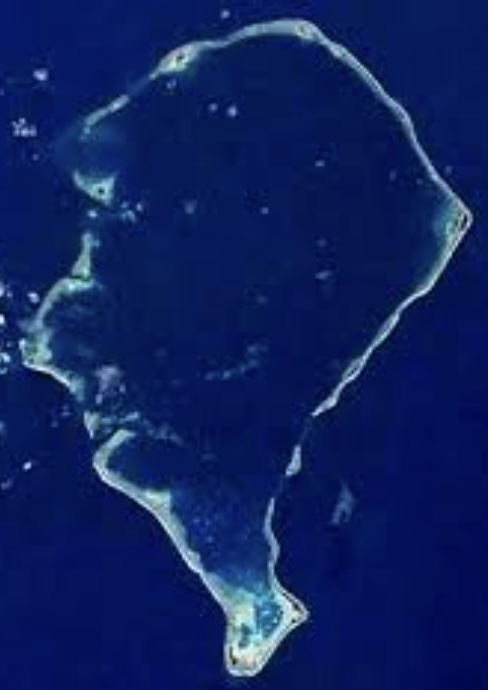
Funafuti, the largest atoll in Tuvalu, seen from space