
June 14, 2026
Global carbon benefits of fishery–photovoltaic integration for sustainable fisheries, energy, and climate mitigation
Thomas J. F. Goreau, PhD, President, Global Coral Reef Alliance
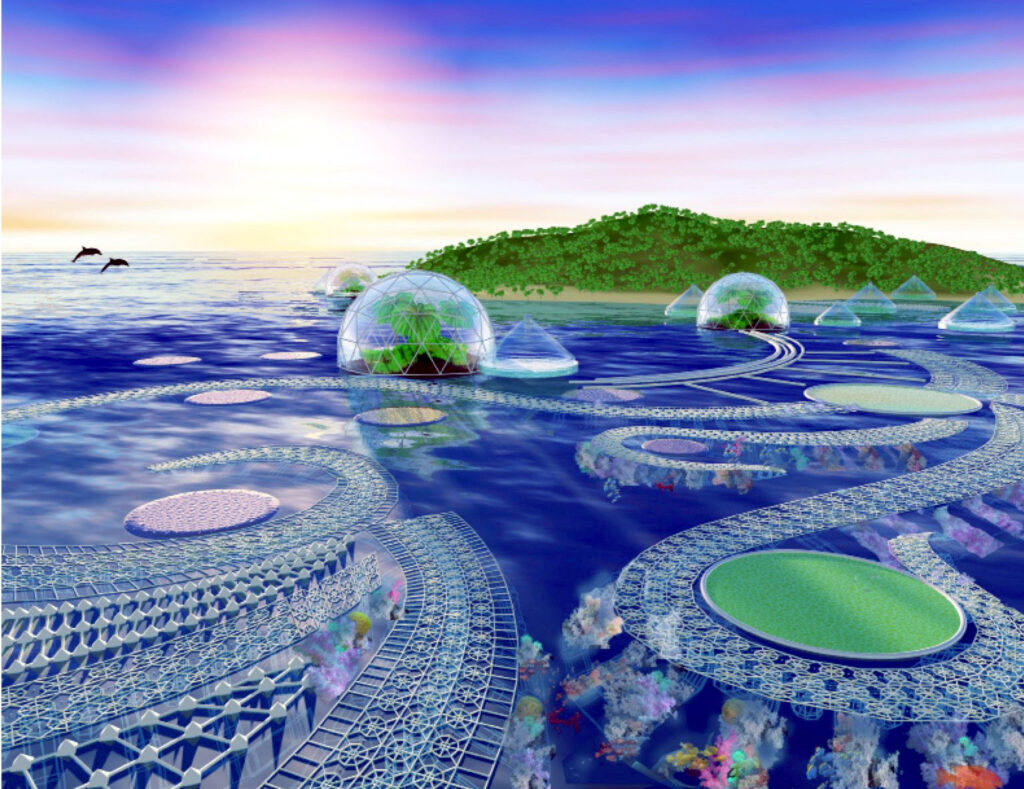
Artist’s rendition of floating Biorock reefs powered by floating solar panels to recharge collapsing Ocean productivity (M. G. Haseltine, 2013, Sustainable reef design to optimize habitat restoration, p. 245-261 in T. J. Goreau & R. K. Trench, Eds., Innovative Methods of Marine Ecosystem Restoration, CRC Press, Boca Raton. Free download of entire book available at https://www.globalcoral.org/innovative-methods-of-marine-ecosystem-restoration/)
Floating solar panel or other ocean energy arrays can have major carbon sequestration and climate benefits as well as economic fisheries benefits. Floating greenhouses can generate fresh water by transpiration of floating mangrove and salt marsh forests, to supply floating cities.
Fishes, especially juveniles, are attracted to, and swarm in, shaded environments under floating objects, attracting their predators in large numbers. This is the basis of Fish Aggregation Devices (FADs) and it is especially effective for fast moving pelagic predators like mahi-mahi (dolphin fish) and tunas. When a Micronesian fisherman finds a floating log, he stays fishing right under it as long as his coconut supply allows him to sail back home. No point wasting time fishing anywhere else!
Floating coral reefs, powered by floating solar panel arrays, are possible over most of the tropical ocean, while at present only about 0.05% of the ocean floor is shallow enough for corals to grow in the light they need. They could transform fisheries in the vast EEZs of Small Island Developing States.
Observations made by diving under floating fish farms in both warm and cold waters reveal the fate of carbon. Almost all floating fish farms are commercial mono-species cultures that are heavily fed, often with non-stop conveyer belts, with commercial fish feed pellets. The vast majority of pellets fall to the bottom uneaten, and rot on the bottom. Commercial salmon farms are reported by divers to have up to 15 or 20 meter high piles of rotting food, mixed with fish excrement, on the bottom. The piles are black with iron sulphides, covered with a thin white layer of sulphide oxidizing bacteria, and are spreading anoxic conditions into the deep fjords favoured by salmon mariculture operations in Chile, Norway, Scotland, Nova Scotia, British Colombia, New Zealand, and other places. These anoxic conditions have created expanding dead zones that have killed large beds of shellfish that Indigenous People, such as the Huilliche of Chilean Patagonia, have lived on for thousands of years. Dead zones in Patagonia have killed the only shallow cold water coral reefs in the world.
Furthermore, extensive use of antibiotics and pesticides in commercial fish and shrimp farms has fueled the evolution of antibiotic-resistant parasites and bacteria that are disseminated to surrounding waters and ecosystems. Many of the most widespread new coral diseases are caused by pathogens that originated in coastal fish and shrimp farms and are spreading throughout the ocean. Cervino, J.M., Thompson, F.L., Gomez‐Gil, B., Lorence, E.A., Goreau, T.J., Hayes, R.L., Winiarski‐Cervino, K.B., Smith, G.W., Hughen, K. and Bartels, E., 2008. The Vibrio core group induces yellow band disease in Caribbean and Indo‐Pacific reef‐building corals. Journal of applied microbiology, 105(5), pp.1658-1671.
We propose a superior strategy to greatly increase economic productivity and carbon benefits, by not adding ANY food, fertilizer, antibiotics, or pesticides, and trickle-charging the entire ecosystem using safe, low-voltage solar panels.
We add no food to Biorock reefs because the biodiversity rises so quickly by spontaneous recruitment of larval fish and invertebrates attracted to electrical fields, that it grows its own food for a complex and complete ecosystem without costly artificial additions, maximizing carbon recycling and minimizing loss from the ecosystem. see T. J. F. Goreau, Biorock Technology: A Novel Tool for Large-Scale Whole-Ecosystem Sustainable Mariculture using Direct Biophysical Stimulation of Marine Organism’s Biochemical Energy Metabolism.
Floating Biorock reefs grew corals, sponges, clams, tunicates, fishes, crabs, and a complex filter-feeding reef community that cleaned the water in a canal in Grand Bahama, and greatly stimulated settlement of beneficial shellfish in Chilean fjords.
Entire floating cities are possible with this technology.
Coupled to floating solar panels, up-wellers, or down-wellers Biorock technology allows intense productivity to be generated, and largely recirculated by pelagic productivity. However, such systems could also be designed to export carbon directly to permanent deep anoxic zones beneath where carbon will be sequestered the longest.
Another key application is to neutralize ocean acidification by growing floating reefs of calcareous algae, which can produce up to 5 Kg of limestone per square metre per year (). We grow them with Biorock at such astonishing rates that we grow back severely eroded beaches at record rates! Deep water coralline algae species like Halimeda copiosa and Halimeda goreaui can be grown to build up limestone sediment fans at the base of continental slopes to neutralize ocean acidification. See Growing coralline algae sand against global climate change, June 2026 at the International Coralline Algae Symposium.
For more information, please contact goreau@globalcoral.org